No, not all angles are right angles; geometry includes acute, obtuse, straight, reflex, and full turns as well as right angles.
Angles pop up in every corner of school maths, yet one question comes up again and again: are all angles right angles? Many learners link the word angle with a neat square corner, so every slanted line can feel confusing. Once you see how angles are measured and named, that doubt starts to fade.
This guide sets out the basic idea of an angle, the main angle types, and the place of right angles inside that list. You will also see where each kind of angle shows up in shapes and daily life, so the phrase are all angles right angles? turns into a quick check you can run in your head.
What Is An Angle?
In geometry an angle shows how much you turn from one direction to another. Take two rays that start from the same point. The shared starting point is the vertex, and the gap between the rays forms the angle.
We measure this turn in degrees. A full turn around a point is 360 degrees. Half a turn, where you face the opposite direction, is 180 degrees. A quarter turn is 90 degrees, and that is the special case called a right angle.
Draw a ray pointing to the right. Now fix the starting point and swing the ray upwards. The number of degrees you sweep through before you stop tells you the size of the angle you have drawn. A small swing gives a small angle. A wide swing gives a large angle.
Angle Types At A Glance
Mathematicians group angles by size, not by how long the rays are. An angle made from very short lines can match an angle made from long lines if the turn is the same. Here are the standard types you will meet again and again in class and in exams.
| Angle Type | Degree Range | Quick Description |
|---|---|---|
| Zero angle | 0° | No turn; both rays lie on top of each other. |
| Acute angle | Greater than 0° and less than 90° | Sharp, narrow corner smaller than a right angle. |
| Right angle | Exactly 90° | Square corner, quarter turn, often marked with a small square. |
| Obtuse angle | Greater than 90° and less than 180° | Wide corner bigger than a right angle but not a straight line. |
| Straight angle | Exactly 180° | Half turn; the two rays form a straight line. |
| Reflex angle | Greater than 180° and less than 360° | Angle that bends back on itself, larger than a straight line. |
| Full angle | Exactly 360° | Complete turn that brings you back to the starting direction. |
If you compare this list with the angle types used in the Khan Academy angle types review, you will see the same family names. Each label tells you something about the size of the turn, and only one of them, the right angle, locks onto 90 degrees exactly.
Once you link these names with degree ranges, questions about angle types stop feeling random. When you see a diagram you can estimate the turn, match it to a range, and choose the right label, even before you pick up a protractor.
Are All Angles Right Angles? Basic Geometry Check
The short answer to the question are all angles right angles? is no. Right angles are just one slice of the full angle family. Any time the turn is not exactly a quarter turn, you are dealing with a different type of angle.
If the turn is smaller than 90 degrees, the angle is acute. If the turn is bigger than 90 degrees but less than a straight line, the angle is obtuse. When the turn lands on a straight line, you have a straight angle. When the turn bends past the straight line but stops before a full turn, it is reflex. A full turn gives a full angle.
This means right angles sit in the middle of the range of possible turns. They form the border between acute angles and obtuse angles. That border feels special because it shows up in many real shapes, but it does not swallow every angle that exists.
Why Only Some Angles Are Right Angles
Right angles tend to appear in designs where people want neat corners and steady structures. Rectangles, squares, most brick walls, many books, screens, and tables use four right angles. Builders rely on them because a square corner makes measuring and lining up pieces easier.
Nature does not follow that pattern. Tree branches meet the trunk with all sorts of turns. Mountain ridges, river bends, and clouds form angles that rarely land exactly on 90 degrees. When you sketch those shapes, you end up with plenty of acute and obtuse angles.
Checking Whether An Angle Is Right
In class you often need to decide quickly whether a corner is a right angle or not. One simple method uses a sheet of paper. The corner of the paper forms a known right angle. Place that corner inside the angle you want to test. If the sides match, you have a right angle. If the corner of the paper sticks out or leaves a gap, the angle is acute or obtuse.
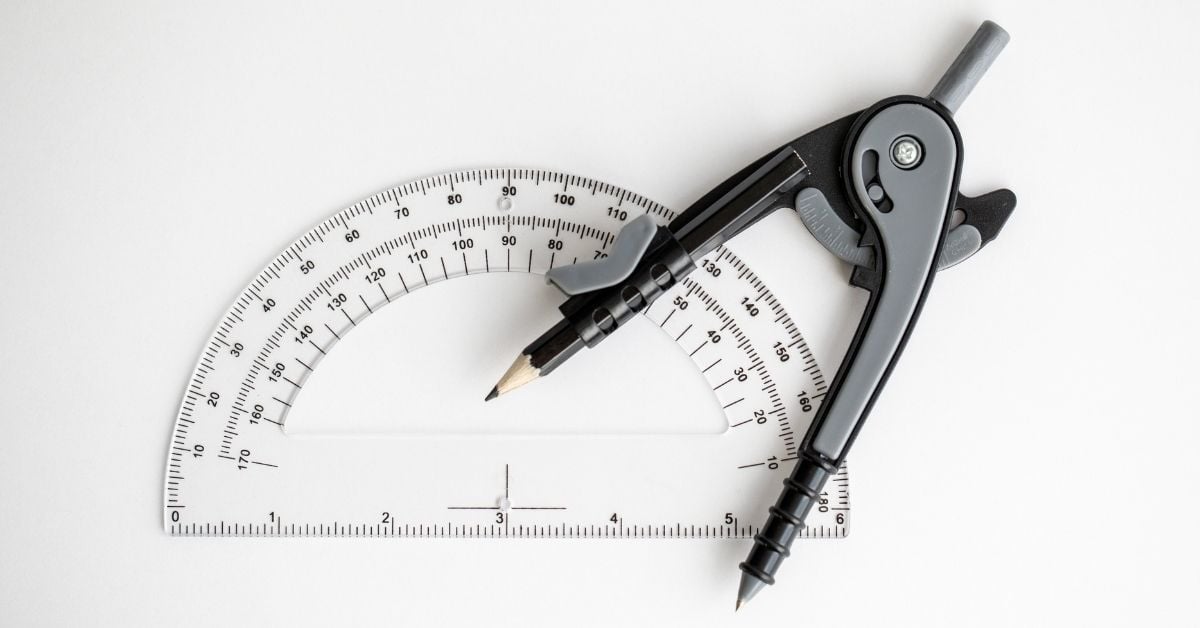
A protractor gives a more exact reading. Line up the baseline of the protractor with one ray, put the centre mark on the vertex, and read off the number where the other ray crosses the scale. If the reading is 90 degrees, the angle is right. If it is less, it is acute. If it is more, it is obtuse, straight, or reflex, depending on the size.
Right Angles Compared With Other Angle Types
Seeing right angles as part of a bigger picture helps with proofs and problem solving. Many angle rules in school maths come down to how turns combine to make 90, 180, or 360 degrees. Knowing where each angle type lands on that scale gives you quick clues.
Two acute angles can add to 90 degrees. When that happens they are called complementary, because together they form a right angle. Two or more angles that add to 180 degrees form a straight angle. Angles that meet around a point add to 360 degrees, matching a full angle.
A straight line can be seen as two right angles placed back to back. A full turn can be seen as four right angles around a point. These links explain why right angles appear in so many angle rules. They act as a natural unit for both shape corners and turns.
Many teaching guides, such as the Third Space Learning angles overview, organise the topic around these totals. Once you see 90, 180, and 360 as targets, you can slice and join angles with far more confidence.
Angles Inside Common Shapes
When students hear the question Are All Angles Right Angles? they sometimes think about the corners of shapes first. Some shapes do rely on right angles, but many do not. Looking at a few standard ones makes this clear.
Squares and rectangles have four right angles. Each corner measures 90 degrees, and the sides meet in neat square corners. That is why squared paper and classroom whiteboards match the idea of a right angle so closely.
Triangles tell a different story. The sum of the angles in any triangle is 180 degrees. In a right triangle, one of those angles is 90 degrees, and the other two are acute. In an acute triangle all three angles are less than 90 degrees. In an obtuse triangle one angle is greater than 90 degrees while the other two are acute.
Quadrilaterals other than rectangles show more variety. A general four sided shape can mix acute and obtuse angles in many ways and still have a total of 360 degrees inside. Parallelograms that are not rectangles have two pairs of equal angles, each pair being acute or obtuse. Kites and trapeziums can contain one, two, or no right angles at all.
Everyday Places Where Angles Are Not Right
Look around a room and you will see far more than right angles. The hands of an analogue clock sweep through every type of angle during the day. At three o’clock they form a right angle. Just before that moment the angle is acute, and just after it becomes obtuse.
Road signs give more examples. A yield or give way sign has the shape of an upside down triangle, so its corners are acute. Warning signs shaped like standard triangles share that pattern. Roundabouts and curved paths draw on reflex angles as drivers steer and turn.
Angle Types And Real Life Examples
The table below pairs each main angle type with a common example. Use it as a quick reference when you revise or when you teach someone else the difference between right angles and the rest.
| Angle Type | Real Life Example | Notes |
|---|---|---|
| Acute angle | Hands of a clock at 1:00 | The minute hand and hour hand form a sharp corner smaller than 90°. |
| Right angle | Corner of a sheet of paper | Each corner of standard paper, books, and screens is a 90° turn. |
| Obtuse angle | Door opened part way | When a door is wide open, the door edge and frame can form more than 90°. |
| Straight angle | Flat road viewed from the side | The line of the road represents a 180° angle at any point along it. |
| Reflex angle | Hands of a clock at 7:00 | The larger gap around the back of the clock face gives an angle greater than 180°. |
| Full angle | One full spin on the spot | A dancer or skater who turns right round has turned through 360°. |
| Zero angle | Closed scissors | When the blades lie together there is no visible gap between them. |
Study Tips For Angle Questions
When angle questions appear on a test paper, time pressure can make everything blur together. A short set of habits can keep things tidy and lower stress.
First, sketch the angle more than once if the diagram looks crowded. A clear copy with the vertex and rays marked helps your brain see whether the turn looks small, square, or wide. Label the angle type and the degree size once you find it.
Next, keep the special totals in mind. Angles on a straight line add to 180 degrees. Angles around a point add to 360 degrees. Complementary angles add to 90 degrees. Each time you spot one of these patterns you can fill in a missing value.
Last, test yourself with quick questions. Point to a corner in your room and decide which type of angle it shows. Check with a right angle tester or a protractor when you can. With enough of these small checks, the question Are All Angles Right Angles? turns into a reminder that right angles are only one part of a broader angle story.